The work, in the order it came
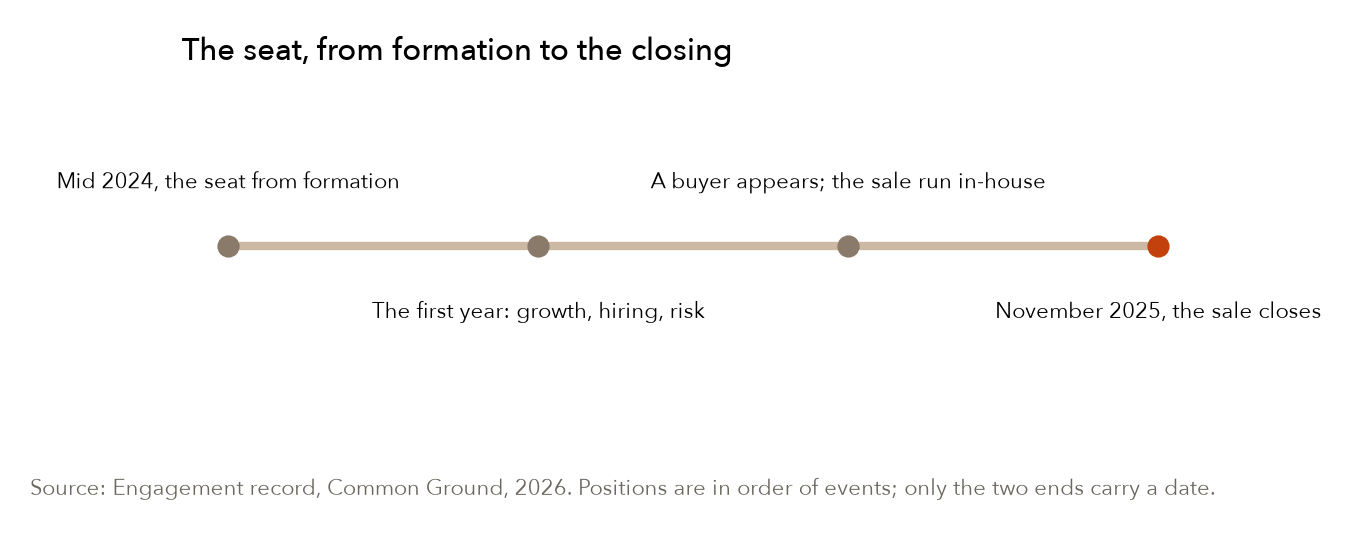
- Drawing the line, at formation. Known: his operating skill, proven hundreds of times. Unknown: how he would handle the calls he had never made. The question was which decisions in front of him sat on a track record he actually had and which did not, because that is the only thing that tells you where presence is worth something and where it is just weight on someone who already knows. It produced a working line: brokering strategy, fleet decisions and client management on his side, untouched; hiring, firing and any sale on the side where I would be in the room. What it changed: he got real distance on nine decisions and me on the tenth.
- The hiring and the firing, through the first year. Known: a growing team and a founder who had never let anyone go. Unknown: whether he would hire past what the business could carry, which is the most common way a capable operator hurts his own company. I stayed in the room for who got hired and who got let go, not to make the calls, but to slow them down at exactly the point where the ways to be wrong multiply. What it changed: the team he sold was the team the business could support.
- When the buyer appeared: the process. Known: one buyer, an organization many times larger, and a relationship into it. Unknown: whether a banker would add anything a fee could justify. The question was what a competitive process is for, and the answer was competitors. There was one buyer and the value was Brandon, so we ran it in-house, the two of us. What it changed: the negotiation stayed a conversation between principals instead of becoming a process.
- Reading the first offer. Known: the number, and the fact that it read to him as a ceiling. Unknown: what the buyer's number assumed. My read was that it priced the firm and not the founder, which is what a first offer from a large acquirer usually does. What it changed: we stopped talking about the number and started writing down what the buyer was actually getting.
- Framing his value in the buyer's terms. Known: the relationships, the book, and the fact that he stays. Unknown: how each of those reads to an organization that size. So we wrote it the way the buyer would price it: what those relationships do inside an operation of that scale, what the book becomes when it is theirs, and what it would cost them to build either without him. Most of the time in the negotiation went here, and the harder half of it was getting my friend to believe it before he had to say it. Part of that work happened on a golf trip, the two of us working the position between rounds while the deal was closing.
- The other equity holders. Known: an exit that takes care of the founder and leaves the minority holders to whatever the documents say is a different outcome from one where somebody worked their side too. I helped structure the deals for the other holders, not just his. What it changed: the closing took care of everyone who had built the firm.
- The closing. Once the framing landed, the offer moved, and it moved fast. The sale closed in November 2025, and the seat ended with the company.
He had more leverage than he thought he did. Most of my job was getting him to see what he was bringing to the table, and then saying it in the room the way the buyer would price it.
What the reframe did to the offer
The one figure in this engagement that a reader could check is the shape of the offer, and I print it as a shape rather than a number, because the price is his and not mine to publish. Once his value was framed the way the buyer would price it, the offer doubled, quickly.
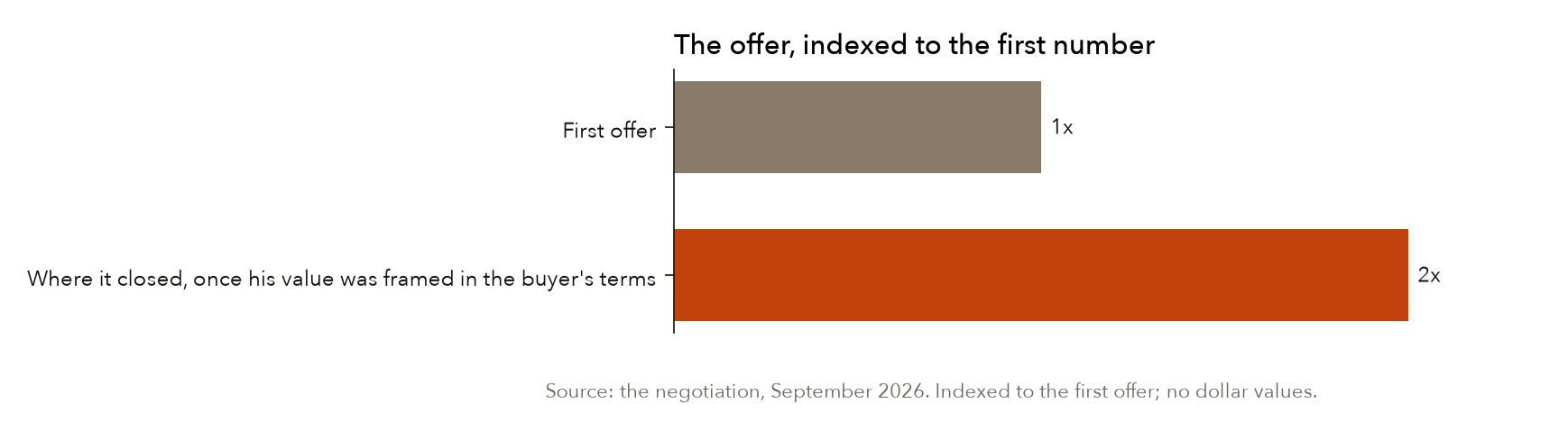
Nothing about the firm changed between the first offer and the last; the relationships, the book and the founder were the same on both days. What changed was the frame the buyer was pricing inside. Priced as a small advisory, the firm was worth a small advisory. Priced as the founder, his relationships and his continuity inside an organization that size, it was worth what it turned out to be worth. The gap between those two numbers was never the buyer being unreasonable. It was the seller not yet having said what he was.
| What the founder was bringing | How it read to him at the first offer | How we framed it for the buyer |
|---|---|---|
| The client relationships | His, and therefore ordinary | Relationships a buyer that size cannot buy any other way |
| The book of business | A small firm's revenue | The revenue as the buyer would earn it inside its own operation |
| The founder himself, staying | A seller, at the buyer's mercy | The only thing that made the other two transfer |
What I kept out of, and the one thing I put in
Kept. Every operating decision. Brokering strategy, fleet questions, how he handled a client: his judgment there was better than mine and I said so. The working line meant trusting him completely on nine decisions so that I could be useful on the tenth.
Replaced. One belief, in one person: that the buyer held the cards. It was replaced with a written account of what he was bringing, in the buyer's own terms, that he could say out loud and defend.
Installed. No process. The engagement was judgment, not systems. What went in was the working line at formation and the one-page account of his value at the sale, which I would carry to any founder selling a firm whose value is himself. The process this engagement touched was the sale itself, and there was none to replace; the founder had never sold a company. With one buyer and a person as the asset, a banker's process would only have put intermediaries in the room at the moment the founder needed to be the one speaking.
What it cost, and what I would watch
It cost the whole run, mid 2024 to the end of 2025, of being fully present on every entrepreneurial decision inside someone else's company, which is not a board seat, it is closer to a second job, taken on the strength of a friendship. It was paid in an asset worth nothing if the exit had not happened. And because I had no stake in the price, there was no upside either, which is the reason I trust the advice: a friend's deal with nothing in it for you is the cleanest test of whether what you told him was right.
What I would watch is what happens to a founder's position the day after a closing. We sold the buyer continuity, which means the buyer bought a person, and a person's value inside a large organization converts into whatever the paper says. That is why the terms mattered as much as the number, for him and for the other holders, and why the last check on a deal like this is that the room's agreement made it onto the page. The other thing I watch is the pattern that made the seat necessary. A founder who underprices himself is not being careless; he is pricing himself the way he has always been priced, as a broker, and it takes someone outside the firm to say that the thing he built is worth more than the thing he does. That is the seat.
What it produced
The offer doubled between the first number and the close, and the sale closed in November 2025. The price is his, not mine to publish.
A slice of the project list
A few related projects.
- Aycre Capital: fund formation and capital raise process (2022 to 2023)
- Canyon Corporate: takeoff, pricing structure and bid revision for an office-to-residential conversion (2026)
- Sublime Medical: fractional COO, cosmetic dermatology group (2015)
- 301 W Osborn: development strategy and entitlement, office-to-condominium conversion (2024 to present)